
ABOUT IAD & THE
IAD FRAMEWORK
Information Architecture Design (IAD) treats information architectures as structured configurations of meaning operating within artificial artefacts, systems, and assemblages. From this perspective:
- IA is the phenomenon.
- IAD is a design-theoretic framework for understanding and working with that phenomenon.
In other words, IA is the subject of inquiry. IAD is one way of studying, explaining, and intentionally engaging with it.
Position
IAD operates within a second intellectual culture of information architecture.
It departs from Library and Information Science-derived models, artefact-bound interpretations of IA and strictly descriptive accounts of structure. Instead it establishes Information Architecture as:
- A compositional activity within design,
- A structural condition of meaning, and
- A mechanism through which social and conceptual realities are composed and made operative.
IAD does not assume a monolithic position. While the theory of IAD may position it closer to or further from other forms of IA, it recognises the value of, and encourages, plurality within the field. IAD is just one school of IA.
TERMINOLOGY
The terms used here distinguish between related but different aspects of IAD.
Information Architecture Design (IAD) refers to the overall design-theoretic position developed here. It establishes IA not merely as a practice of organisation or navigation, but as a compositional activity within design concerned with the structural design of meaning.
The IAD Canon refers specifically to the body of theory supporting this position: the structured and interrelated system of concepts, arguments, constructs, and supporting artefacts developed over time.
The IAD Framework refers to the interaction layer designed around this work. It includes the conceptual structures, content models, materials and artefacts, environments and happenings through which IAD may be encountered, discussed and debated, taught, practiced and applied, and extended. This website is but one instantiation of the framework.
Conceptual Engine
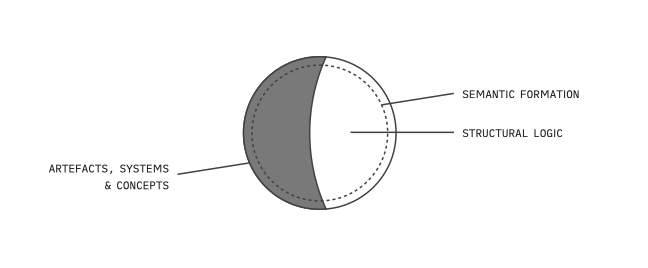
IAD is grounded in a compositional account of meaning structured through three interdependent constructs:
- Structural Logic (SL) — the organisation and relation of elements within a structure
- Semantic Formation (SF) — the coherence through which meaning is apprehended as a whole
- Contrived Ontology (CO) — the intentional inscription of meaning into artefacts, systems, and social formations
Structural Logic (SL) and Semantic Formation (SF) are distinct but mutually inclusive concepts. Contrived Ontology (CO) manifests as the gestalt outcome of SL and SF when information architectures are operative in social reality.
Canon Structure
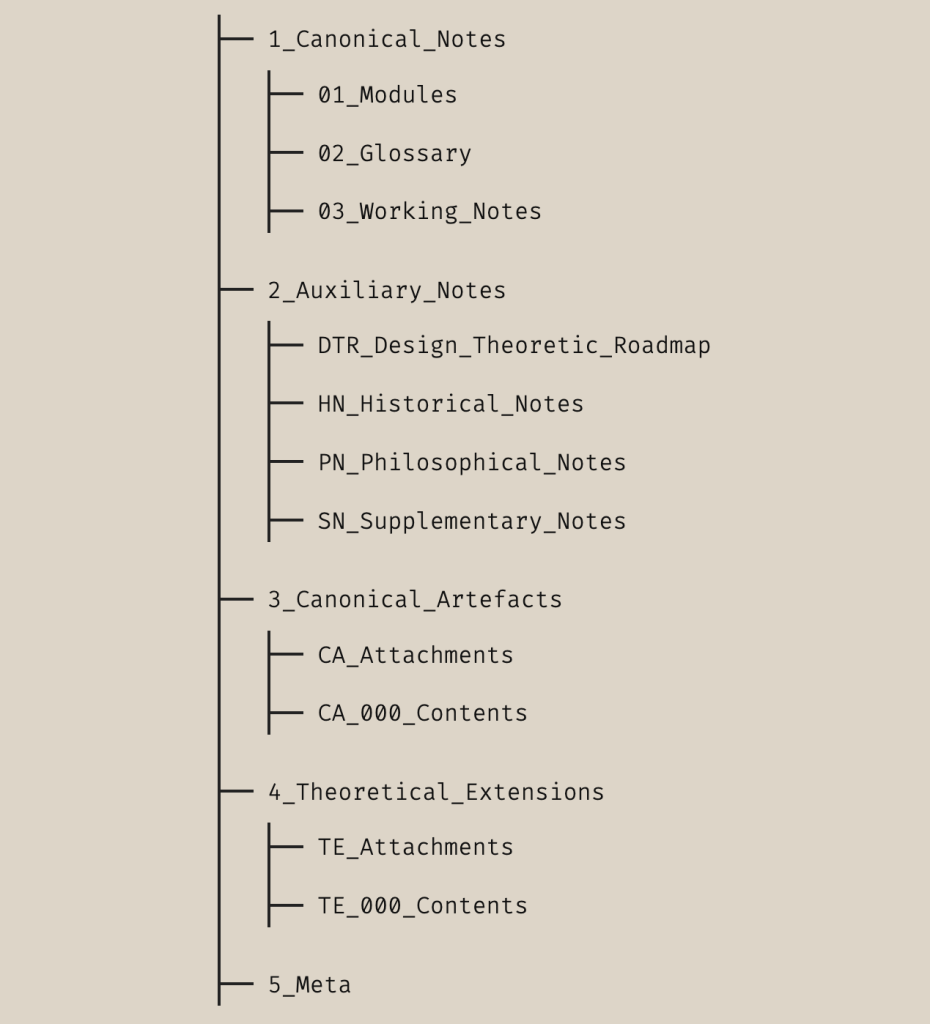
FRAMEWORK STRUCTURE
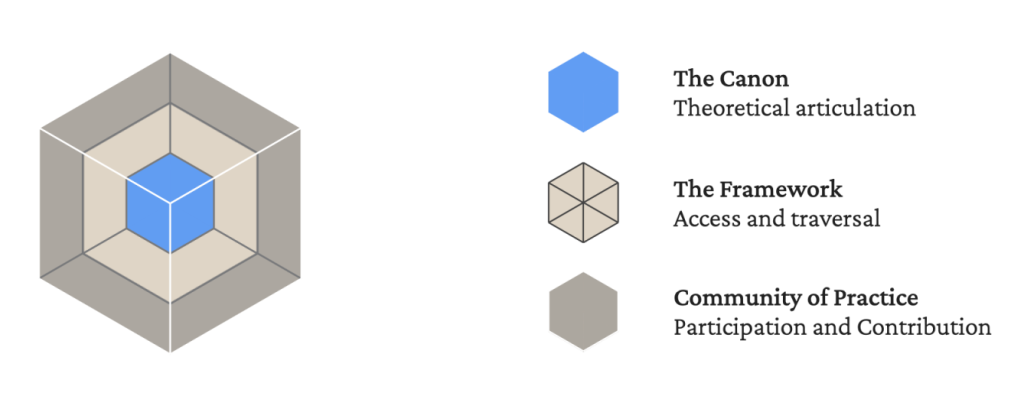
| The Canon | The Framework | CoP & Society |
|---|---|---|
| The structured body of theory comprising canonical modules, glossary entries, auxiliary notes, models, diagrams, conceptual artefacts, and related materials developed to formalise and extend the theory of IAD. | The operational and experiential architecture through which the canon may be encountered, explored, interpreted, taught, discussed, and applied across multiple contexts and levels of participation. | The emerging intellectual and cultural environment formed through participation, contribution, discourse, teaching, practice, critique, and the continued development of IAD as a contemporary learned society model. |
| Includes: modules, glossary entries, auxiliary notes, diagrams, conceptual artefacts, examples, theoretical structures, developmental trajectories | Includes: the website, pathways, encounters, pedagogical materials, lectures, applications, participation structures, onboarding systems, releases | Includes: discussion groups, studio critiques, guest lectures, contribution pathways, governance structures, collaborations, publications, field-building activities |
DEVELOPMENT & VISION
While work on the theory and framework to date has largely been that of a few individuals, the intention moving forward is three-fold:
- To encourage interest, debate and extensions to that which currently exists
- To accept contributions to the development of the theory, practise, praxis and pedagogy of the field, and
- To ultimately move the canon and framework to a not-for-profit entity governed and maintained by the community of the field representing disciplinary, professional and public interests.
ORIGIN OF THE WORK
The IAD Canon is an original body of work in Information Architecture Design, by Jason Hobbs.
It draws from:
- Academic research into meaning-making and design
- Professional practice across products, systems, services, and strategy
- A structured canon of concepts, models, and methods developed through three decades of research, teaching, and professional practice.
The work sits between theory and practice:
- Grounded in design inquiry
- Tested in real-world contexts
- Formalised as a coherent framework
This work has informed teaching in Information Architecture, including at the University of Michigan School of Information (2025-2026).
IAD
ENCOUNTER
— 001
THE
FRAMEWORK
Encounter 001 marks the beginning of the public release of the IAD Canon and Framework. Across two live sessions, participants will engage the Canon theory directly through discussion, creative studio-based exercises, and guided traversal through the conceptual terrain of IAD.
The theory at the
centre of the Framework.
– Currently in preparation